2025
Enabling enterprise customers to manage budgets across teams
As Superside moved upmarket, enterprise account growth was hitting a structural limit. Larger organisations needed to manage spending across multiple teams — but the platform had no concept of team-level budgets.
Customers worked around it by splitting into multiple accounts, making spending impossible to track and blocking consolidation.
This was a retention and expansion risk. Customers couldn't scale within the platform, and Superside couldn't grow with them.
ROLE
Lead product designer
TEAM
1 Project manager
4 FE/BE engineers
Product marketing, customer success, leadership
IMPACT
• One enterprise account grew from $30k to $45k/month following team adoption
• Enabled account consolidation — 3 accounts into 1
• Foundation for enterprise retention and expansion at scale
THE PROBLEM
A structural limit on enterprise growth
Enterprise customers were managing teams through multiple disconnected accounts — a workaround that increased admin overhead, fragmented spend visibility, and prevented Superside from growing alongside its largest customers.
The business needed a way to support team-level budget ownership without a full platform redesign.
01
Customer workarounds
Teams created multiple accounts to separate budgets, making spending difficult to track and increasing administrative overhead.
02
Blocked consolidation and growth
Large customers could not easily consolidate teams under one account, limiting account expansion and enterprise adoption.
03
Business and technical constraint
The platform’s account-based budget model prevented organisations from managing spending at the team level.
DESIGN STRATEGY
Introducing team-based budget ownership
I introduced a team-based budgeting model, shifting spending control from the account level to individual teams.
This allowed organisations to allocate budgets to specific teams while maintaining visibility and control across the entire account.
01. Start small: validate the model before committing to complexity
Rather than redesigning the backend upfront, the first question was: does team-based budgeting actually unlock enterprise growth? The MVP answered that.
The initial iteration introduced team creation and budget allocation, allowing organisations to assign spending limits to individual teams and test whether team-based budgeting could support enterprise customers and unlock account expansion.
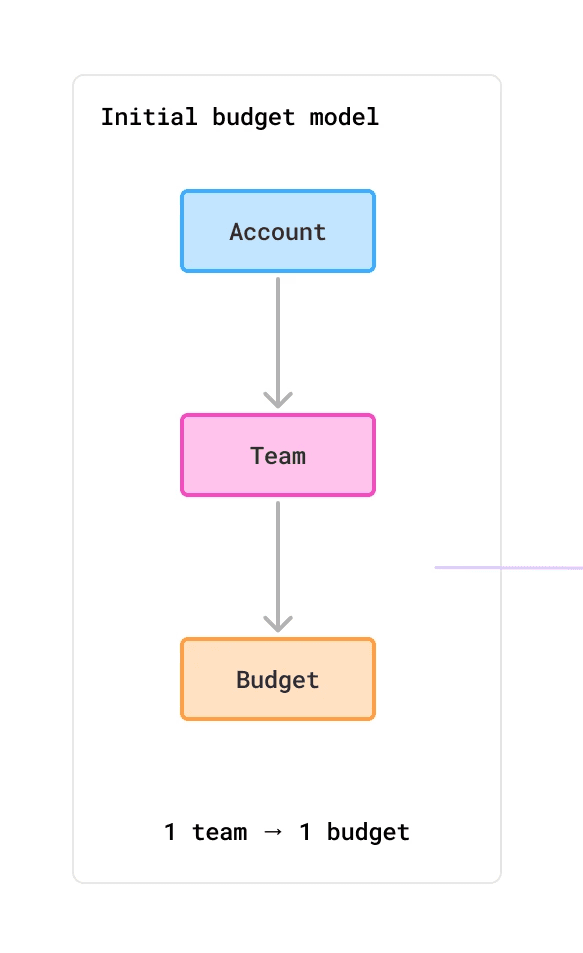
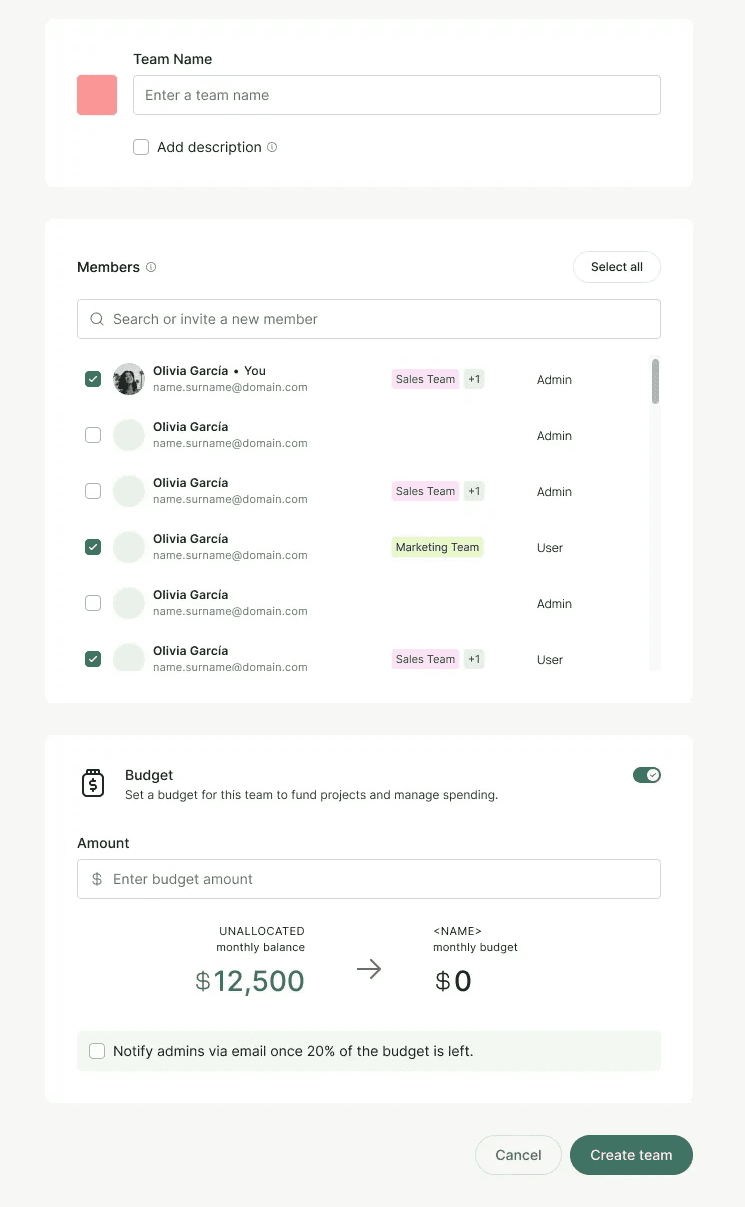
The MVP introduced team creation and budget allocation, validating the team-based budgeting model with minimal backend complexity.
02. Enable teams to manage their own budgets
Once the MVP validated the model, the backend expanded to support full team-level budget management.
Teams could monitor their budget and spending in real time, while account owners retained a consolidated view across all teams. This balance of team autonomy and central oversight enabled organisations to control spending while maintaining visibility at the account level.
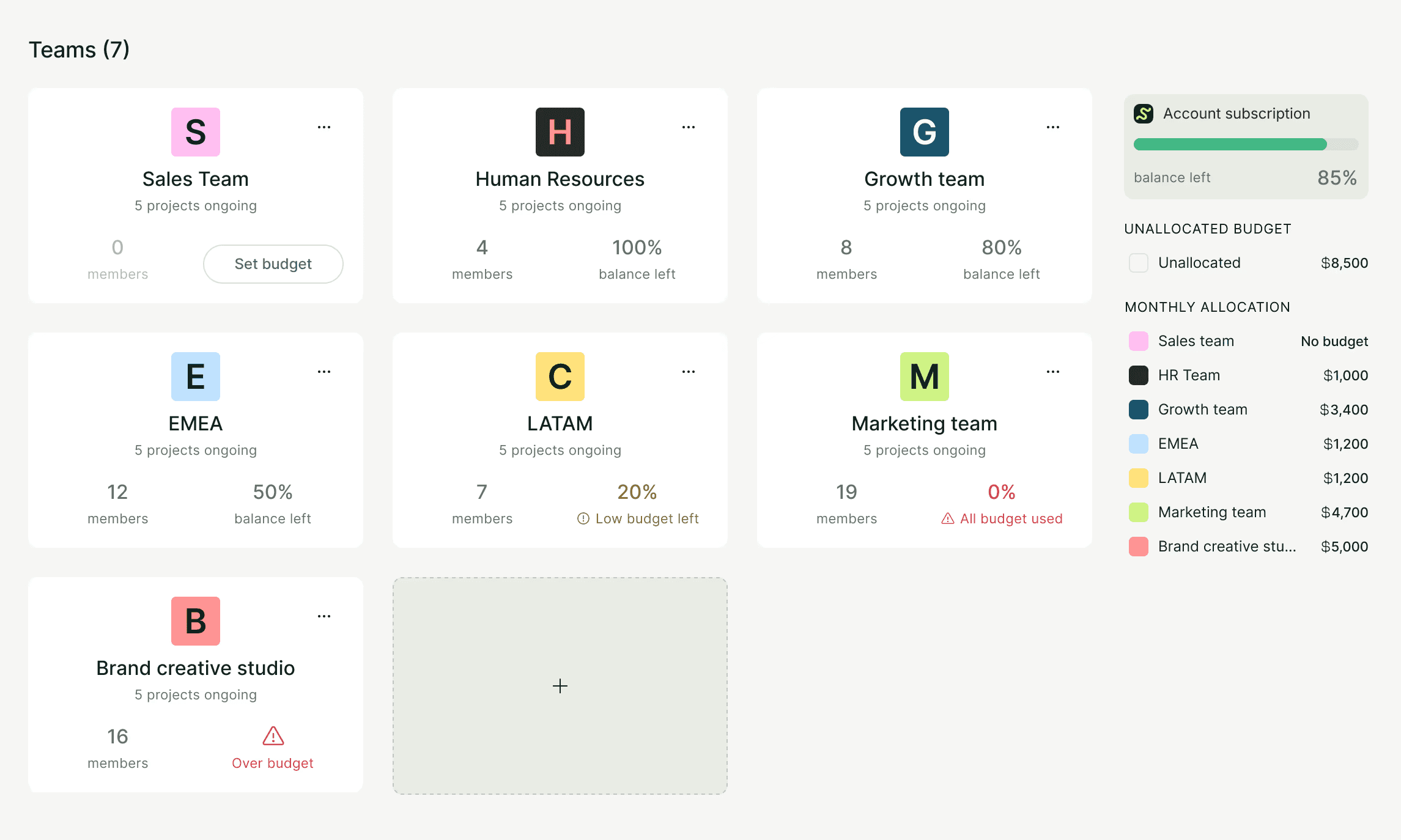
Budgets became operational within real workflows. Projects were allocated to teams, allowing spending to be tracked against team budgets.
03. As adoption grew, so did the complexity — and the opportunity
The MVP linked one budget to each team, validating the concept and supporting core enterprise use cases.
As adoption grew, organisations needed greater flexibility to manage spending across multiple teams and shared budgets. Exploration focused on a model where budgets and teams could be decoupled, enabling more flexible spending structures.
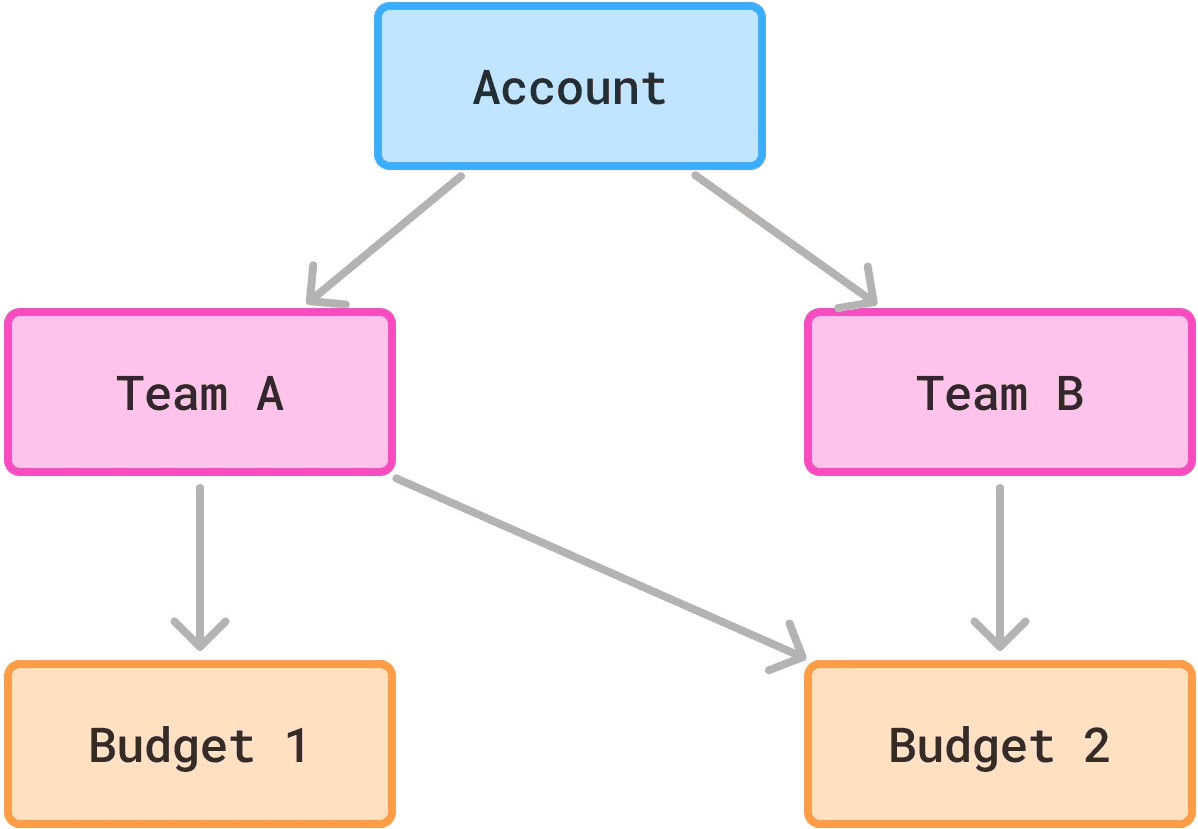
Exploration prototype (try it )
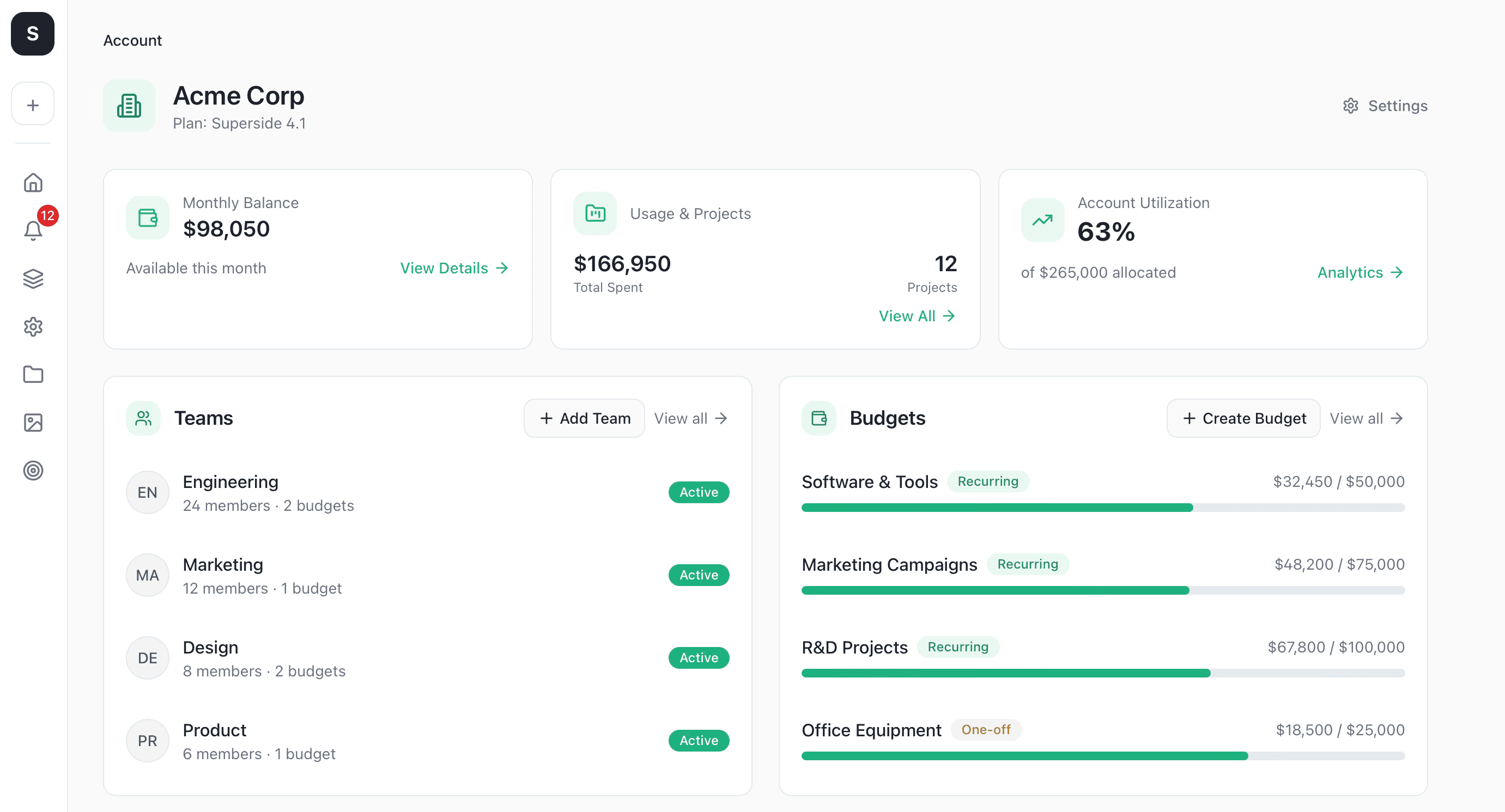
This prototype explored how team budgets could support more flexible relationships between teams, projects, and account-level spending.
IMPACT & RESULTS
From fixing workarounds to unlocking growth
Introducing team-based budgets removed the structural barrier to enterprise account growth. Customers could now scale within a single account — managing budgets independently while maintaining central visibility — and Superside could grow with them.
One enterprise customer consolidated 3 accounts into 1, reaching $30k/month, then expanded to $45k/month following team adoption. Enabling enterprise-grade budget workflows directly supported retention and expansion, and laid the foundation for more advanced enterprise capabilities on the platform.